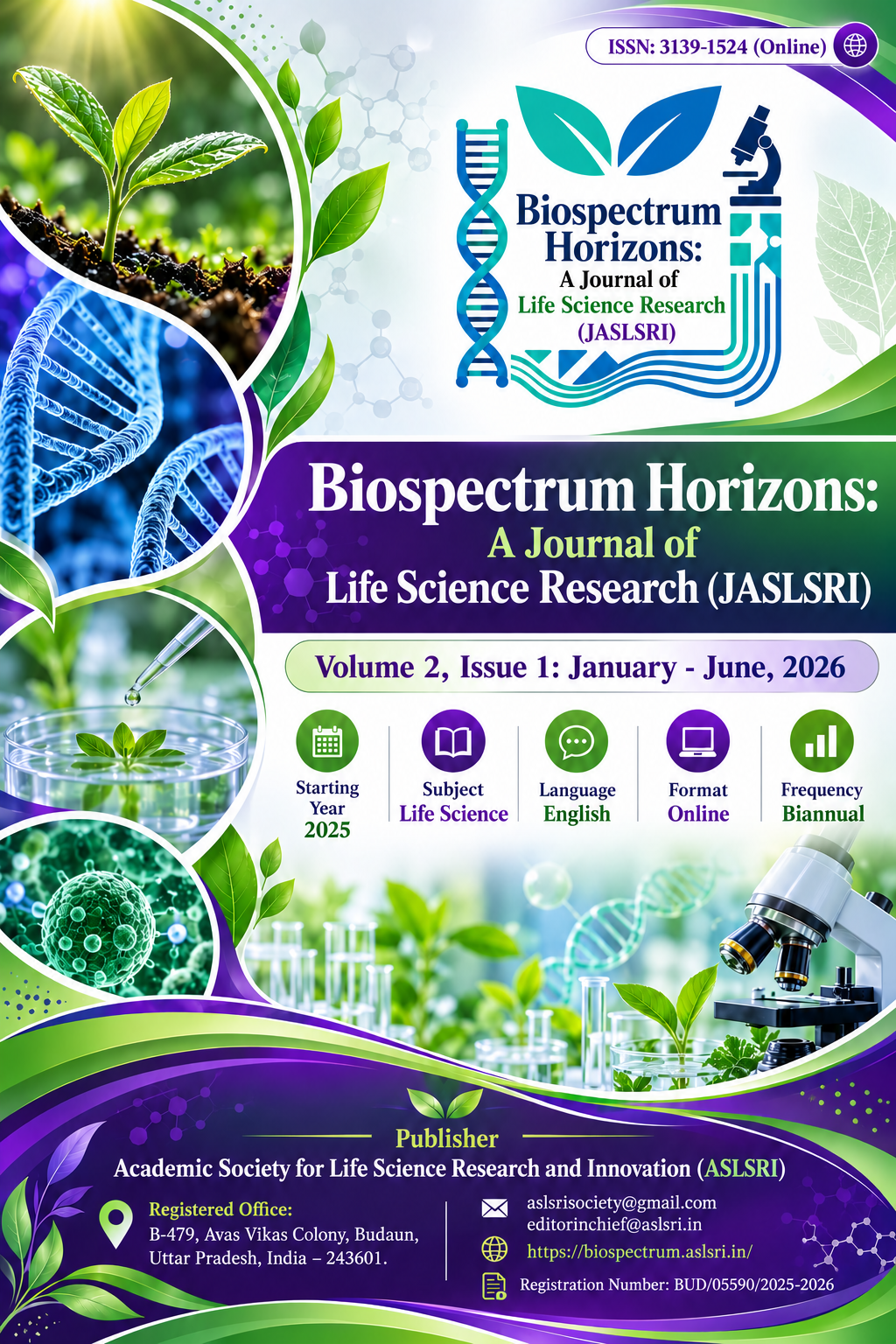
Biospectrum Horizons: A Journal of Life Science Research (JASLSRI)

e-ISSN: 3139-1524 • CC BY 4.0

CC BY 4.0 e-ISSN: 3139-1524

Biospectrum Horizons: A Journal of Life Science Research

The Biospectrum Horizons: A Journal of Life Science Research (JASLSRI) is an international, peer-reviewed, open-access journal dedicated to high-quality research and innovation across life sciences, biotechnology, and interdisciplinary scientific fields. Published by the Academic Society for Life Science Research and Innovation (India), JASLSRI provides a platform for original research, reviews, and significant scientific contributions spanning biological sciences, environmental sciences, biotechnology, bioinformatics, microbiology, agriculture, medical sciences, and related disciplines. The journal promotes scientific excellence, academic integrity, methodological rigor, and interdisciplinary collaboration. All manuscripts undergo a rigorous double-blind peer-review process, with emphasis on originality, scientific significance, ethical standards, and research quality.
JASLSRI welcomes researchers worldwide and aims to connect scientific discovery with meaningful real-world applications, fostering collaboration and innovative research for sustainable development and the advancement of life sciences.

Showing results for: "ASP" Clear search ×
Featured Publication
Cover
JASLSRI Vol 2

Volume 2, Issue 1 (January - June, 2026)

Browse Table of Contents →
15 Articles
59 Views
45 Downloads
📢

Journal Announcements & Calls for Papers

View All Announcements →
CALL FOR PAPERS Oct 13, 2026

Call for Papers – Volume 2, Issue 2 (2026)

We are accepting papers for the volume 2 issue 2 of our journal.

Search Results

3 Publications Found

CC BY 4.0 Open Access
Biological & Molecular Sciences • Vol 2, Issue 1 (2026)
Open Access

Sustainable Agriculture and Food Security : A Review of Current Practices and Future Directions

Authors: Dr. Anoop Kumar Dr. Avneesh Kumar Gautam

As the world continues to see an unprecedented amount of growth, it will also begin to see incredible fluctuations in its climate. Given this combination of factors, we are now at a significant turning point where we need to make a massive shift towards more sustainable agriculture in order to provide food security for the long term. Sustainable agriculture is not just about how farmers grow food; it encompasses all aspects of growing food in a holistic manner that also includes protecting the environment from destruction while still being able to feed the growing world population today and help the next generation (future generations) with their ability to feed themselves. The projected global population will increase to approximately 9.6 billion by 2050, thus there is a need for food security alongside sustainable agricultural practices and ultimately, to provide solutions to achieving the Sustainable Development Goals (S.D.G.). Therefore, this article provides an overview of the latest developments and trends in sustainable agriculture and food security while also outlining the major challenges, opportunities, and policy choices that are needed to achieve sustainable agricultural systems and food security in the future. This article examines how utilizing various sustainable agriculture practices, such as agroecology, organic farming, conservation agriculture, climate-smart agriculture, can help to improve food security and soil health, protect biodiversity, and build resilience to climate change. It discusses the importance of supporting small-scale farmers by improving their access to markets and modern technologies, promoting climate resilient agricultural practices, and reducing food loss and waste along the food supply chain.

Sustainable agriculture food security food waste
👁 8 ⬇ 5 Read HTML →
Biological & Molecular Sciences • Vol 2, Issue 1 (2026)
Open Access

Critical Slowing Down and Regime Shifts: Assessing Early-Warning Indicators of Climate-Driven Transitions

Authors: Nisha Verma Rajeev Kumar Yadav

As climate changes, ecological and socio-economic systems will become increasingly vulnerable, and the likelihood of experiencing abrupt and irreversible changes (known as tipping points) will increase. Tipping points are the points of no return in terms of switching between different regimes. For example, if there are small ecological changes in an ecosystem (e.g., loss of biodiversity), they can lead to a disproportionately large response from the ecosystem (e.g., shifting from one ecosystem form to another). One of the most important aspects of climate adaptation science is understanding how these transitions occur; how to identify early-warning signals to detect them; and how to improve the resilience of socio-environmental systems to these transitions. The current study investigates several of the dynamics and factors that are involved in climate-induced tipping points, including: feedback loops; biodiversity loss; and biogeochemical stressors, as well as early-warning indicators, such as: critical slowing down; increased variance; spatial correlation; and flickering. Improved long-term monitoring and increased opportunities for continued modelling of these early-warning signals may improve our ability to anticipate climate-related tipping points. The discussion also encompasses socio-environmental resilience, noting anticipatory, autonomous, and transformative adaptations and governance models which would support society to cope with uncertainty. We must incorporate tipping-point science into policies to address ecological collapse and reduce cascading social risks. Resilience in integrated human nature systems is to be developed through coordinated governance, community involvement, ecological restoration and flexible adaptation strategies and especially as climate pressures intensify and the risk of crossing irreversible thresholds increases, the paper concludes.

Climate change; tipping points; regime shifts; socio-environmental resilience; early-warning signals; ecological thresholds; adaptive governance; climate adaptation; critical slowing down; ecosystem stability.
👁 4 ⬇ 8 Read HTML →
Biological & Molecular Sciences • Vol 1, Issue 1 (2025)
Open Access

Aquatic Insects as Bio-Indicators of Water Quality: A Study on Chukka Beach and Sharda Sagar Dam (PTR), Pilibhit, Uttar Pradesh, India

Authors: Barkha Sanjana Rani Arti Kumari

The aquatic ecosystems of Chukka Beach (Sharda River) and the Sharda Sagar Dam within the Pilibhit Tiger Reserve (PTR), Uttar Pradesh, represent ecologically important freshwater habitats of the Terai landscape. The present study (2023–2025) investigates the diversity, abundance, and bioindicator role of aquatic insects in assessing the water quality of these two contrasting aquatic sites. A total of 18 aquatic insect species belonging to major orders such as Ephemeroptera, Trichoptera, Odonata, Coleoptera, Hemiptera, Diptera and Megaloptera were documented. Standard sampling (sweep netting, kick sampling, hand picking) and physicochemical analyses were used to study the interaction between aquatic insect assemblages and water quality parameters. Diversity indices (Shannon–Wiener, Simpson’s Dominance, Margalef Richness) were calculated seasonally for both sites. Bioassessment indices including BMWP, ASPT, and Family Biotic Index (FBI) were applied to evaluate the ecological condition of the water bodies. Correlation analysis revealed strong associations between insect diversity and key environmental variables such as pH, indicating that slightly alkaline conditions support healthier insect communities. In contrast, fluoride, arsenic, BOD, COD, TDS, Water temperature and copper (Cu) showed negative correlations with species richness and abundance .But in sensitive taxa like Ephemeroptera and Trichoptera showed higher representation at Chukka Beach, indicating relatively better water quality, whereas tolerant groups such as Chironomidae, Culicidae, Ceratopogonidae, Psychodidae, Tabanidae (Diptera) were more abundant near the Sharda Sagar Dam influenced by anthropogenic activities. Canonical Correspondence Analysis (CCA) further illustrated how environmental gradients shape the community structure., suggesting Higher TDS and copper levels also contributed to declining diversity, indicating overall degradation of water quality. Correlation analysis showed that aquatic insect diversity positively correlated with pH because even slightly alkaline conditions favour healthy insect communities. On the other hand--Water temperature, pH, Nitrate, Total alkalinity, Dissolved oxygen (DO), Nitrate, TDS, BOD and COD identified correlations with the richness and abundance of species. Among them, arsenic, BOD and COD had the strongest negative effects, which implies that toxic chemicals and organic contamination reduce species richness of sensitive taxa. Higher TDS and copper content was also associated with diminished diversity and hence general deterioration of water quality. Altogether, the results provide supporting evidence for aquatic insects to be good bio-indicators of health in freshwater resource of Pilibhit area. The study is of significance as it offers an opportunity for baselines for conservation monitoring of the Sharda River system, and its conservation planning and sustainable management.

Aquatic insects Bioindicators Water quality
👁 2 ⬇ 1 Read HTML →

Editors-in-Chief

Leadership
UK

Prof. Upendra Kumar

Editor-in-Chief

Professor, Department of Botany, Mahatma Jyotiba Phule Rohilkhand University, Bareilly, India, India

PS

Dr. Priyanka Singh

Editor-in-Chief

Assistant Professor, Government Degree College, Budaun, U.P., India, India

Journal Focus Areas

  • • Biological & Molecular Sciences: Cell Biology, Molecular Biology, Genetics, Biochemistry, Biotechnology
  • • Environmental, Agricultural & Applied Life Sciences: Environmental Biology, Ecology, Agriculture, Plant Sciences, Animal Sciences, Food Science
  • • Microbiology & Biomedical Sciences: Microbiology, Immunology, Medical Biology, Pharmacology, Biomedical Research
  • • Other Life Science & Interdisciplinary Studies: Bioinformatics, Computational Biology, Neuroscience, Marine Biology, interdisciplinary and emerging life-science fields
Call For Papers / Announcement

Call for Papers: Volume 2, Issue 2 (2026)
Submissions are currently open for peer review in Molecular Biology, Biotechnology, Microbiology, Bioinformatics, Environmental Sciences, Agricultural Sciences, and related areas of Life Science Research.

Submit Manuscript →

Abstracting & Indexing

Verified
Google Scholar