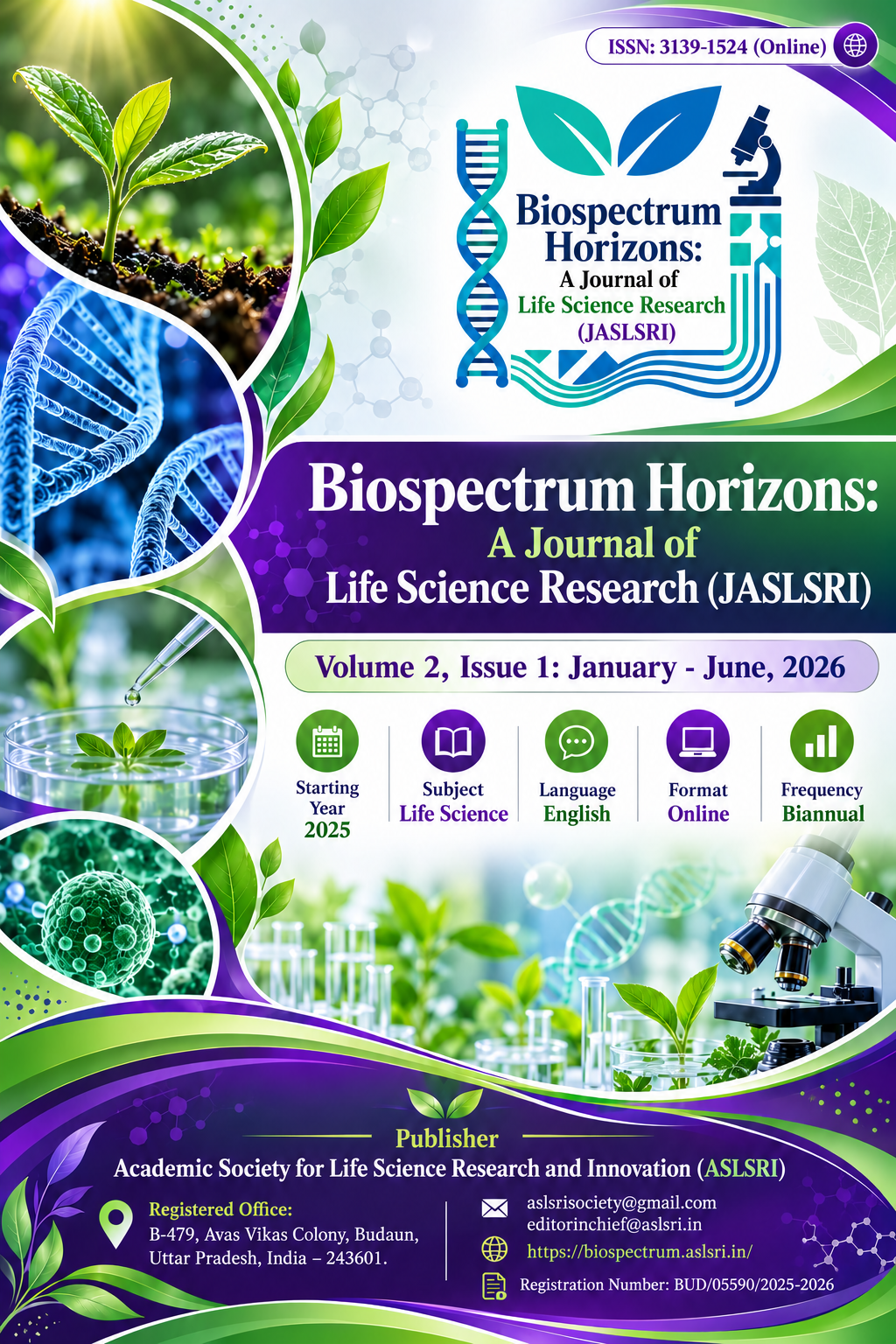
Biospectrum Horizons: A Journal of Life Science Research (JASLSRI)

e-ISSN: 3139-1524 • CC BY 4.0

CC BY 4.0 e-ISSN: 3139-1524

Biospectrum Horizons: A Journal of Life Science Research

The Biospectrum Horizons: A Journal of Life Science Research (JASLSRI) is an international, peer-reviewed, open-access journal dedicated to high-quality research and innovation across life sciences, biotechnology, and interdisciplinary scientific fields. Published by the Academic Society for Life Science Research and Innovation (India), JASLSRI provides a platform for original research, reviews, and significant scientific contributions spanning biological sciences, environmental sciences, biotechnology, bioinformatics, microbiology, agriculture, medical sciences, and related disciplines. The journal promotes scientific excellence, academic integrity, methodological rigor, and interdisciplinary collaboration. All manuscripts undergo a rigorous double-blind peer-review process, with emphasis on originality, scientific significance, ethical standards, and research quality.
JASLSRI welcomes researchers worldwide and aims to connect scientific discovery with meaningful real-world applications, fostering collaboration and innovative research for sustainable development and the advancement of life sciences.

Showing results for: "Heavy metals" Clear search ×
Featured Publication
Cover
JASLSRI Vol 2

Volume 2, Issue 1 (January - June, 2026)

Browse Table of Contents →
15 Articles
79 Views
63 Downloads
📢

Journal Announcements & Calls for Papers

View All Announcements →
CALL FOR PAPERS Oct 13, 2026

Call for Papers – Volume 2, Issue 2 (2026)

We are accepting papers for the volume 2 issue 2 of our journal.

Search Results

1 Publications Found

CC BY 4.0 Open Access
Biological & Molecular Sciences • Vol 1, Issue 1 (2025)
Open Access

Differential Effects of Lead Nitrate and Cadmium Nitrate on Proline Accumulation and Associated Quantitative, and Morphological traits in M2 generation of Linum usitatissimum L.

Authors: Nidhi Sharma Sana Choudhary Nazarul Hasan Neha Naaz Parul Verma

This study evaluated the mutagenic effects of lead nitrate and cadmium nitrate on proline accumulation and various quantitative traits and morphological variations in M1 and M2 generations of Linum usitatissimum L. Both mutagens reduced plant height, branching, capsule number, seed weight, and yield, with cadmium nitrate resulting in stronger suppression. Proline content increased significantly in the M1 generation of linseed under both heavy metal’s treatment, indicating a strong biochemical response to heavy-metal stress. Although proline content declined in the M2 generation, but the content remained higher than the control. This increased proline in second generation revealed a partial recovery towards the induced stress. Various distinct cotyledonary and floral mutations were recorded in treated populations, some of which were persisted into the M2 generation. These findings shows heavy metal lead and cadmium nitrate although reduced the growth parameters but the mutants with high proline accumulation can serve as a better adaptor towards stress and may help in identifying mutant lines with improved stress tolerance for future breeding programmes.________________________________________

Linum Heavy metals lead nitrate
👁 4 ⬇ 3 Read HTML →

Editors-in-Chief

Leadership
UK

Prof. Upendra Kumar

Editor-in-Chief

Professor, Department of Botany, Mahatma Jyotiba Phule Rohilkhand University, Bareilly, India, India

PS

Dr. Priyanka Singh

Editor-in-Chief

Assistant Professor, Government Degree College, Budaun, U.P., India, India

Journal Focus Areas

  • • Biological & Molecular Sciences: Cell Biology, Molecular Biology, Genetics, Biochemistry, Biotechnology
  • • Environmental, Agricultural & Applied Life Sciences: Environmental Biology, Ecology, Agriculture, Plant Sciences, Animal Sciences, Food Science
  • • Microbiology & Biomedical Sciences: Microbiology, Immunology, Medical Biology, Pharmacology, Biomedical Research
  • • Other Life Science & Interdisciplinary Studies: Bioinformatics, Computational Biology, Neuroscience, Marine Biology, interdisciplinary and emerging life-science fields
Call For Papers / Announcement

Call for Papers: Volume 2, Issue 2 (2026)
Submissions are currently open for peer review in Molecular Biology, Biotechnology, Microbiology, Bioinformatics, Environmental Sciences, Agricultural Sciences, and related areas of Life Science Research.

Submit Manuscript →

Abstracting & Indexing

Verified
Google Scholar