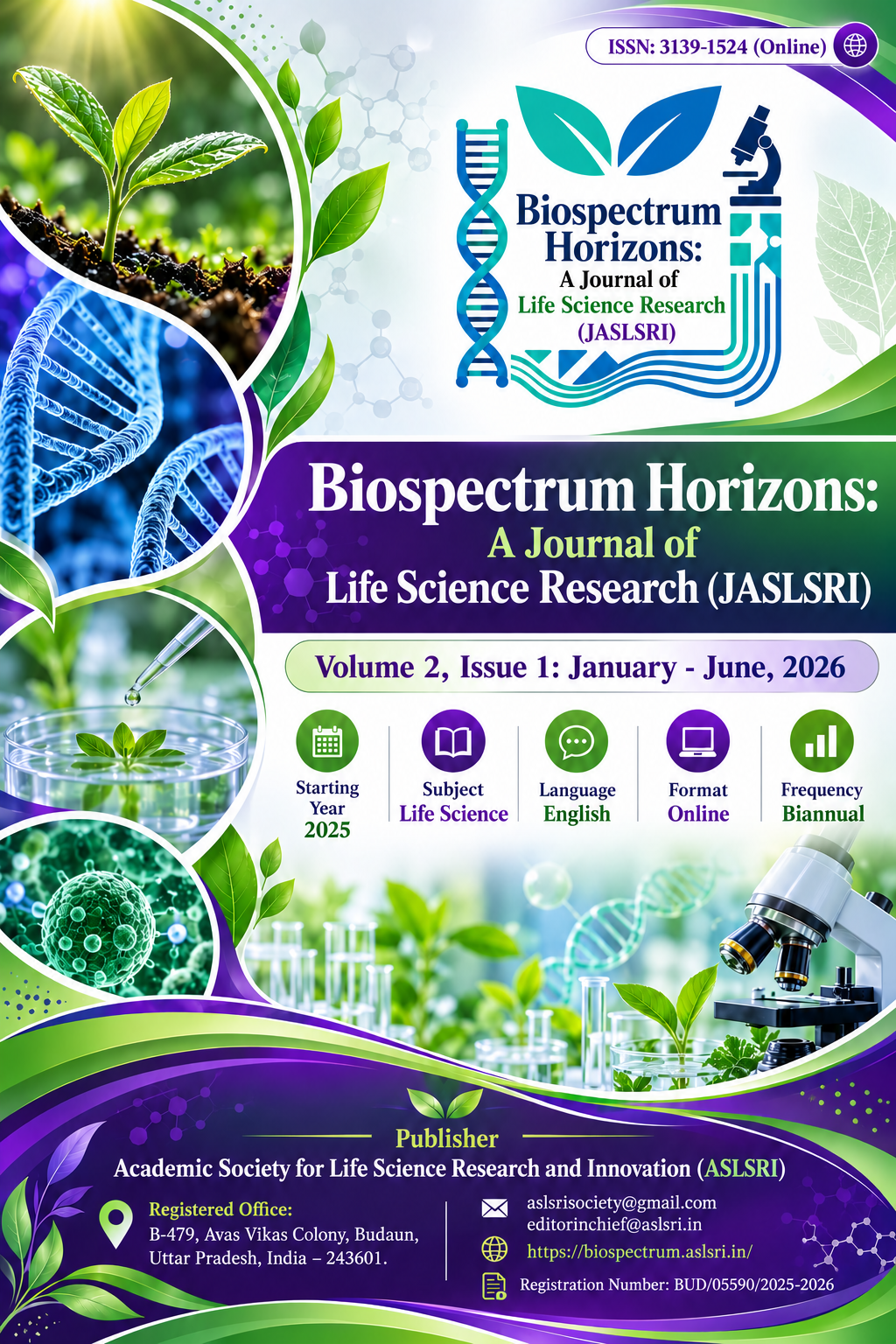
Biospectrum Horizons: A Journal of Life Science Research (JASLSRI)

e-ISSN: 3139-1524 • CC BY 4.0

CC BY 4.0 e-ISSN: 3139-1524

Biospectrum Horizons: A Journal of Life Science Research

The Biospectrum Horizons: A Journal of Life Science Research (JASLSRI) is an international, peer-reviewed, open-access journal dedicated to high-quality research and innovation across life sciences, biotechnology, and interdisciplinary scientific fields. Published by the Academic Society for Life Science Research and Innovation (India), JASLSRI provides a platform for original research, reviews, and significant scientific contributions spanning biological sciences, environmental sciences, biotechnology, bioinformatics, microbiology, agriculture, medical sciences, and related disciplines. The journal promotes scientific excellence, academic integrity, methodological rigor, and interdisciplinary collaboration. All manuscripts undergo a rigorous double-blind peer-review process, with emphasis on originality, scientific significance, ethical standards, and research quality.
JASLSRI welcomes researchers worldwide and aims to connect scientific discovery with meaningful real-world applications, fostering collaboration and innovative research for sustainable development and the advancement of life sciences.

Showing results for: "Soil nematodes; Wheat agroecosystem; Trophic structure; Biodiversity; Bioindicators; Soil health" Clear search ×
Featured Publication
Cover
JASLSRI Vol 2

Volume 2, Issue 1 (January - June, 2026)

Browse Table of Contents →
15 Articles
59 Views
45 Downloads
📢

Journal Announcements & Calls for Papers

View All Announcements →
CALL FOR PAPERS Oct 13, 2026

Call for Papers – Volume 2, Issue 2 (2026)

We are accepting papers for the volume 2 issue 2 of our journal.

Search Results

1 Publications Found

CC BY 4.0 Open Access
Biological & Molecular Sciences • Vol 1, Issue 1 (2025)
Open Access

Diversity, Abundance, and Distribution of Soil Nematode Communities in Wheat Agroecosystems

Authors: Gaurav Kumar Singh

Soil nematodes are a part of soil food webs and are sensitive indicators of soil ecological conditions. In this study, the diversity, abundance, trophic structure and temporal distribution of soil nematode communities in a wheat (Triticum aestivum L.) agroecosystem were evaluated over a period of one year. We collected soil samples on 8 occasions from June 2008 to April 2009, with cover ranging from different crop growth stages, including fallow periods, in a conventionally cultivated wheat field, Aligarh district, India. Nematodes were obtained by modified Cobb’s sieving and decantation followed by Baermann funnel technique and identified to the generic level. A total of 50 nematode genera with 10 orders and 30 families were identified. Number of genera per sample varied from 13 to 23, with total nematode abundance being between 105 to 1178 individuals. The most abundant order was Rhabditida, and Dorylaimida had the highest level of generic diversity. Within trophic groups, bacteriovores were the most common organisms (58%) and were followed by fungivores (21%), herbivores (13%), omnivores (5%), and predators (3%). The most common genus throughout the course of the study was Acrobeloides. The measured trophic diversity index was from 1.03 to 1.25, suggesting moderate trophic complexity. Seasonal dynamics were well recorded with high levels of bacteriovorous nematodes in post-harvest periods, probably as a consequence of the higher organic matter content generated due to crop residues. The evidence indicates that soil nematode community structure is highly determined by crop phenology, organic amendments and the season. Soil nematode faunal analysis was used in this study and is effective for assessing soil health and ecosystem functioning in wheat-based agroecosystems.

Soil nematodes; Wheat agroecosystem; Trophic structure; Biodiversity; Bioindicators; Soil health
👁 3 ⬇ 1 Read HTML →

Editors-in-Chief

Leadership
UK

Prof. Upendra Kumar

Editor-in-Chief

Professor, Department of Botany, Mahatma Jyotiba Phule Rohilkhand University, Bareilly, India, India

PS

Dr. Priyanka Singh

Editor-in-Chief

Assistant Professor, Government Degree College, Budaun, U.P., India, India

Journal Focus Areas

  • • Biological & Molecular Sciences: Cell Biology, Molecular Biology, Genetics, Biochemistry, Biotechnology
  • • Environmental, Agricultural & Applied Life Sciences: Environmental Biology, Ecology, Agriculture, Plant Sciences, Animal Sciences, Food Science
  • • Microbiology & Biomedical Sciences: Microbiology, Immunology, Medical Biology, Pharmacology, Biomedical Research
  • • Other Life Science & Interdisciplinary Studies: Bioinformatics, Computational Biology, Neuroscience, Marine Biology, interdisciplinary and emerging life-science fields
Call For Papers / Announcement

Call for Papers: Volume 2, Issue 2 (2026)
Submissions are currently open for peer review in Molecular Biology, Biotechnology, Microbiology, Bioinformatics, Environmental Sciences, Agricultural Sciences, and related areas of Life Science Research.

Submit Manuscript →

Abstracting & Indexing

Verified
Google Scholar