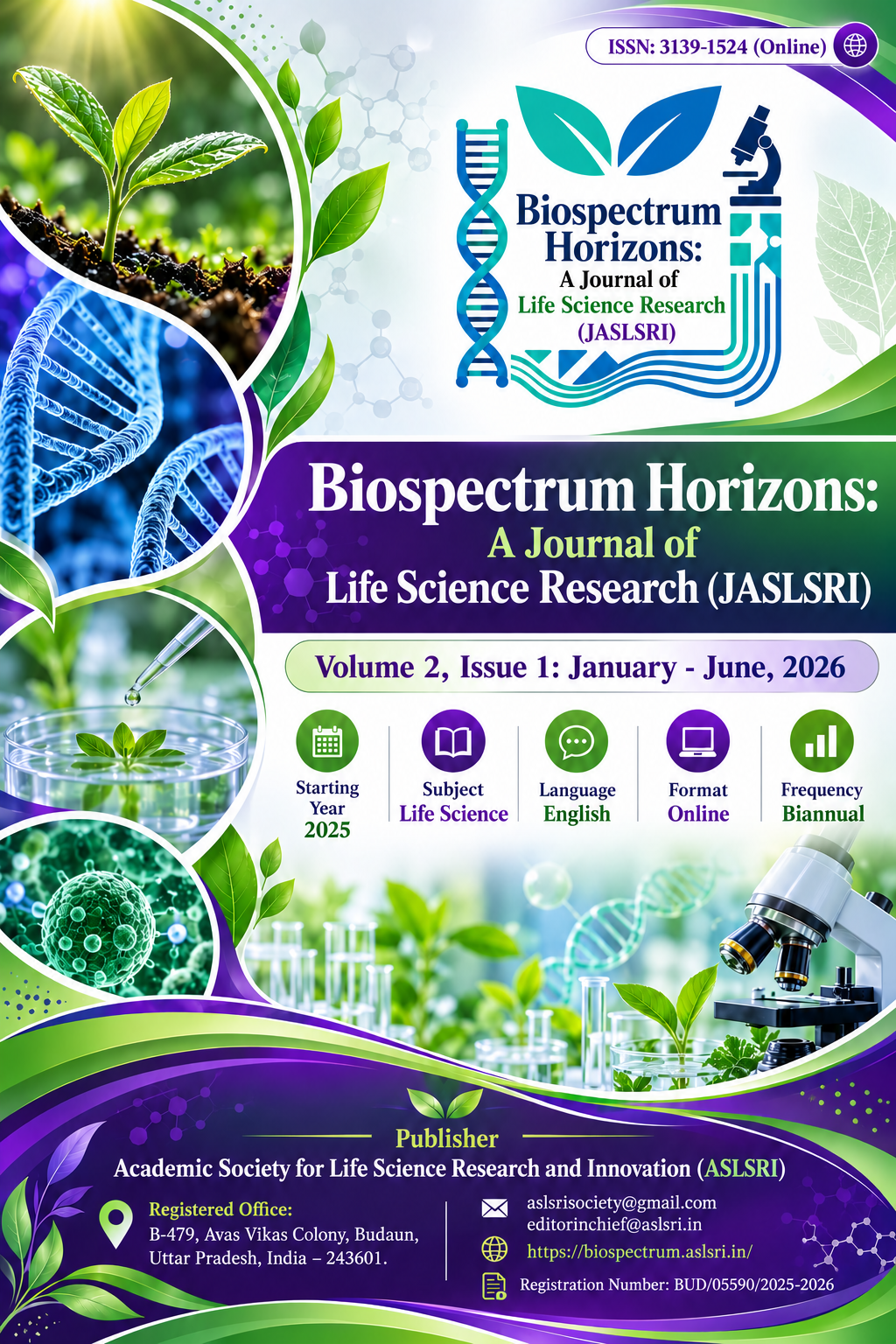
Biospectrum Horizons: A Journal of Life Science Research (JASLSRI)

e-ISSN: 3139-1524 • CC BY 4.0

CC BY 4.0 e-ISSN: 3139-1524

Biospectrum Horizons: A Journal of Life Science Research

The Biospectrum Horizons: A Journal of Life Science Research (JASLSRI) is an international, peer-reviewed, open-access journal dedicated to high-quality research and innovation across life sciences, biotechnology, and interdisciplinary scientific fields. Published by the Academic Society for Life Science Research and Innovation (India), JASLSRI provides a platform for original research, reviews, and significant scientific contributions spanning biological sciences, environmental sciences, biotechnology, bioinformatics, microbiology, agriculture, medical sciences, and related disciplines. The journal promotes scientific excellence, academic integrity, methodological rigor, and interdisciplinary collaboration. All manuscripts undergo a rigorous double-blind peer-review process, with emphasis on originality, scientific significance, ethical standards, and research quality.
JASLSRI welcomes researchers worldwide and aims to connect scientific discovery with meaningful real-world applications, fostering collaboration and innovative research for sustainable development and the advancement of life sciences.

Showing results for: "climate change." Clear search ×
Featured Publication
Cover
JASLSRI Vol 2

Volume 2, Issue 1 (January - June, 2026)

Browse Table of Contents →
15 Articles
47 Views
30 Downloads
📢

Journal Announcements & Calls for Papers

View All Announcements →
CALL FOR PAPERS Oct 13, 2026

Call for Papers – Volume 2, Issue 2 (2026)

We are accepting papers for the volume 2 issue 2 of our journal.

Search Results

2 Publications Found

CC BY 4.0 Open Access
Biological & Molecular Sciences • Vol 2, Issue 1 (2026)
Open Access

Sustainable Agriculture and Food Security : A Review of Current Practices and Future Directions

Authors: Dr. Anoop Kumar Dr. Avneesh Kumar Gautam

As the world continues to see an unprecedented amount of growth, it will also begin to see incredible fluctuations in its climate. Given this combination of factors, we are now at a significant turning point where we need to make a massive shift towards more sustainable agriculture in order to provide food security for the long term. Sustainable agriculture is not just about how farmers grow food; it encompasses all aspects of growing food in a holistic manner that also includes protecting the environment from destruction while still being able to feed the growing world population today and help the next generation (future generations) with their ability to feed themselves. The projected global population will increase to approximately 9.6 billion by 2050, thus there is a need for food security alongside sustainable agricultural practices and ultimately, to provide solutions to achieving the Sustainable Development Goals (S.D.G.). Therefore, this article provides an overview of the latest developments and trends in sustainable agriculture and food security while also outlining the major challenges, opportunities, and policy choices that are needed to achieve sustainable agricultural systems and food security in the future. This article examines how utilizing various sustainable agriculture practices, such as agroecology, organic farming, conservation agriculture, climate-smart agriculture, can help to improve food security and soil health, protect biodiversity, and build resilience to climate change. It discusses the importance of supporting small-scale farmers by improving their access to markets and modern technologies, promoting climate resilient agricultural practices, and reducing food loss and waste along the food supply chain.

Sustainable agriculture food security food waste
👁 8 ⬇ 4 Read HTML →
Biological & Molecular Sciences • Vol 1, Issue 1 (2025)
Open Access

Biodiversity in India: Present Threats, Conservation Policies and the Role of Indian Legislation

Authors: Preeti Verma

India is one of the 17 megadiverse countries, hosting approximately 7–8% of all recorded species on just 2.4% of the world’s land area. With four global biodiversity hotspots (Himalaya, Indo-Burma, Western Ghats–Sri Lanka and Sundaland), the country supports over 55,481 plant taxa and 105,244 animal species as of 2024 (Botanical Survey of India, 2025; Zoological Survey of India, 2025). Despite robust legal and policy frameworks, biodiversity faces severe threats from habitat fragmentation, deforestation (18,200 ha of primary humid forest lost in 2024), invasive alien species, pollution, overexploitation and climate change. This manuscript synthesizes the latest data from the Botanical Survey of India (BSI), Zoological Survey of India (ZSI), Global Forest Watch, India State of Forest Report 2023 and IUCN Red List, while critically examining India’s biodiversity-related legislation: the Wildlife (Protection) Act 1972 (as amended 2022), Biological Diversity Act 2002 (Rules 2004 & Amendment 2023), Forest (Conservation) Act 1980 (amended 2023), Environment (Protection) Act 1986, Scheduled Tribes and Other Traditional Forest Dwellers (Recognition of Forest Rights) Act 2006 and recent regulations under the Jan Vishwas Act 2023 and Biological Diversity (Access and Benefit Sharing) Regulations 2025 (Government of India). The analysis reveals implementation gaps, judicial interventions and emerging opportunities under the Kunming-Montreal Global Biodiversity Framework. Strengthening enforcement, community rights, landscape-level planning and climate-resilient corridors is essential for achieving national targets of protecting 30% of land and water by 2030.

Biodiversity deforestation invasive species
👁 1 ⬇ 0 Read HTML →

Editors-in-Chief

Leadership
UK

Prof. Upendra Kumar

Editor-in-Chief

Professor, Department of Botany, Mahatma Jyotiba Phule Rohilkhand University, Bareilly, India, India

PS

Dr. Priyanka Singh

Editor-in-Chief

Assistant Professor, Government Degree College, Budaun, U.P., India, India

Journal Focus Areas

  • • Biological & Molecular Sciences: Cell Biology, Molecular Biology, Genetics, Biochemistry, Biotechnology
  • • Environmental, Agricultural & Applied Life Sciences: Environmental Biology, Ecology, Agriculture, Plant Sciences, Animal Sciences, Food Science
  • • Microbiology & Biomedical Sciences: Microbiology, Immunology, Medical Biology, Pharmacology, Biomedical Research
  • • Other Life Science & Interdisciplinary Studies: Bioinformatics, Computational Biology, Neuroscience, Marine Biology, interdisciplinary and emerging life-science fields
Call For Papers / Announcement

Call for Papers: Volume 2, Issue 2 (2026)
Submissions are currently open for peer review in Molecular Biology, Biotechnology, Microbiology, Bioinformatics, Environmental Sciences, Agricultural Sciences, and related areas of Life Science Research.

Submit Manuscript →

Abstracting & Indexing

Verified
Google Scholar